GTM Bench v1
MNBGZoomInfoPaperJun 2026
The question
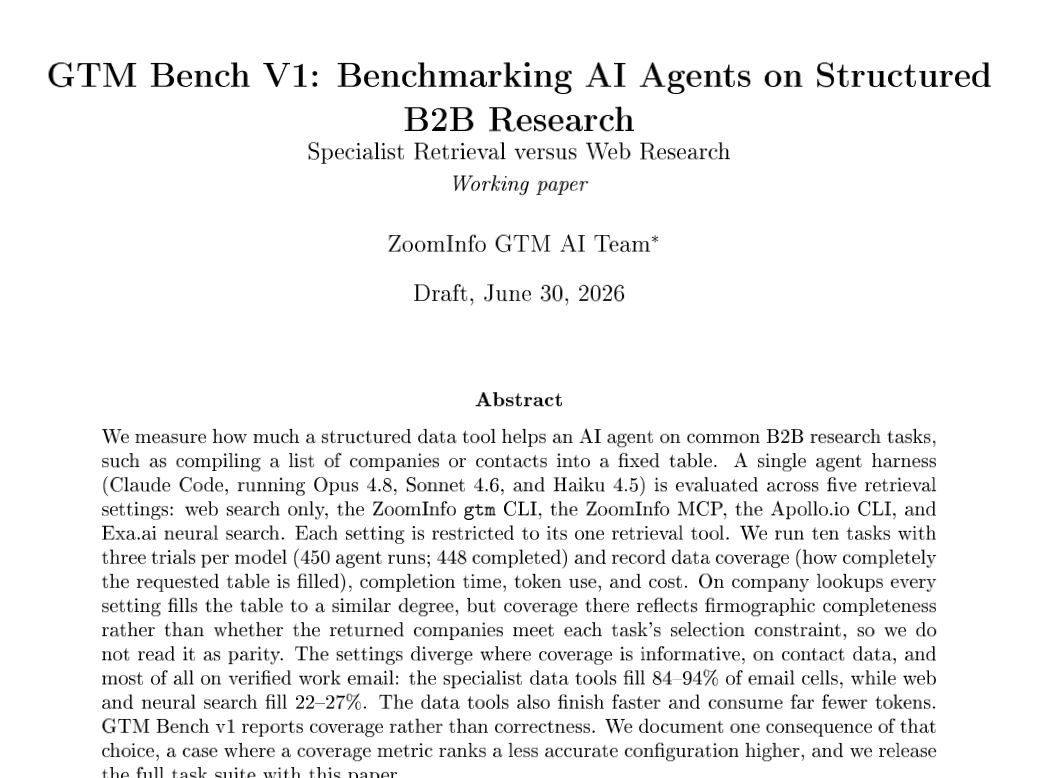
Sales and marketing teams now point AI agents at research that used to be manual analyst work: find 50 NYC companies that just raised funding, or 20 AI CTOs in the Bay Area with email and LinkedIn. Two things decide how well an agent answers: the model's reasoning, and the data tools it can reach. GTM Bench isolates the second. Given the same agent and the same prompt, how much does the retrieval tool matter?
The setup
One agent harness (Claude Code on Opus 4.8, Sonnet 4.6 and Haiku 4.5), five retrieval settings, each locked to a single tool: web search only, the gtm CLI, the ZoomInfo MCP, the Apollo.io CLI, and Exa neural search. Ten tasks across company discovery, contact discovery, enrichment and buyer intent, three trials per model: 450 runs, 448 completed. Each run fills a fixed table, and is scored on coverage (how completely the table is filled), time, tokens and cost.
What it found
- Contact data is where the tools separate. The specialist data tools fill 84–94% of verified work-email cells; web and neural search fill 22–27%.
- Structured retrieval is cheaper and faster. On Opus, the web baseline cost about four times the gtm CLI and used more than twenty times the work tokens. The ZoomInfo MCP had the lowest total time.
- Company lookups look like a tie, but aren't. Every setting fills firmographic tables equally well, but coverage doesn't check whether the companies meet the task's constraint (recently funded, running Salesforce), which is exactly what structured filters establish.
The lesson for agent benchmarks
Coverage can rank a less accurate configuration higher. On one enrichment task the CLI's coverage rose as the model got smaller, because Haiku filled cells by enriching the wrong company where Opus correctly left them empty. A completeness metric on its own rewards confident guessing, so v2 will pair coverage with correctness.