Workbounce
AQDGWorkbounceCompany2021Updated Oct 2026
Knowledge graphs · Ontologies · LLMs · Unsupervised learning · Python
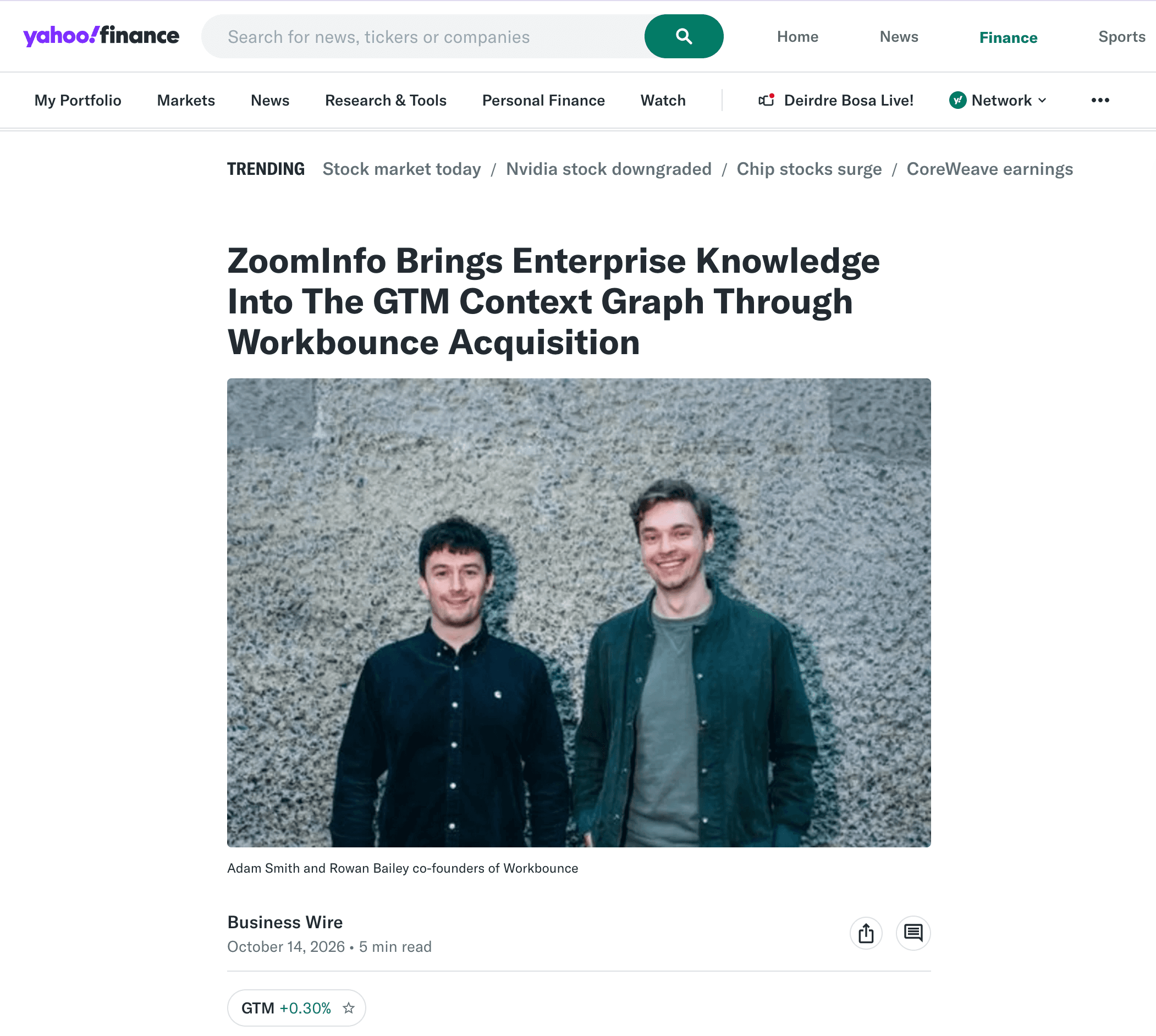
I co-founded Workbounce with Rowan Bailey in 2021 after we both left Peakon. We raised a $2.7M seed round from Index Ventures in March 2022 and sold the company to ZoomInfo in late 2024. I was CEO and CTO, built the product, and stayed active in the codebase throughout.
The problem
A company's most useful knowledge is usually its most scattered. For sales and revenue teams, the real answers live across Slack threads, call transcripts, emails, decks, Google Drive, Notion, and Confluence rather than in any clean system of record. We started out building a "Google meets Slack" search and knowledge product for revenue teams, and as LLMs got capable enough to reason over messy text, the product grew into a full semantic knowledge layer for enterprise data.
Knowledge graphs, ontologies, and ML
Flat vector search falls apart quickly on enterprise data because chunks lose the structure of who said what, about which account or product, and when. A lot of our technical work went into building a company-specific knowledge graph directly from unstructured sources:
- Ontology-based extraction with LLMs. We used LLMs to extract entities, attributes, and typed relationships against an ontology from raw Slack conversations, transcripts, and docs, turning scattered text into a structured graph that agents and search could actually reason over. Much of my later thinking in Competence and Coherence came straight out of hitting these enterprise ontology problems in production.
- Clustering and unsupervised learning. Teams won't maintain manual tags or folder taxonomies for long, so we leaned heavily on embeddings, clustering, and unsupervised learning to group related threads, recurring questions, objections, and topics automatically and surface patterns across a company's corpus.
- Small targeted ML models. LLMs weren't cheap or fast enough to run over every incoming event, so we paired them with small supervised models where it made sense, like the Slack question classifier that triaged hundreds of thousands of Slack messages on CPU before escalating real questions to a larger model.
Acquisition and ZoomInfo
ZoomInfo acquired Workbounce in late 2024, and Rowan and I joined to bring the technology into ZoomInfo's AI stack. The acquisition stayed quiet for roughly two years while we integrated it, before ZoomInfo formally announced the integration in October 2026.
Press & archive
- TechCrunch (March 2022)
- Index Ventures (March 2022)
- Acquisition note on LinkedIn (November 2024)
- The Workbounce Journal (Substack)
Screenshots (2)
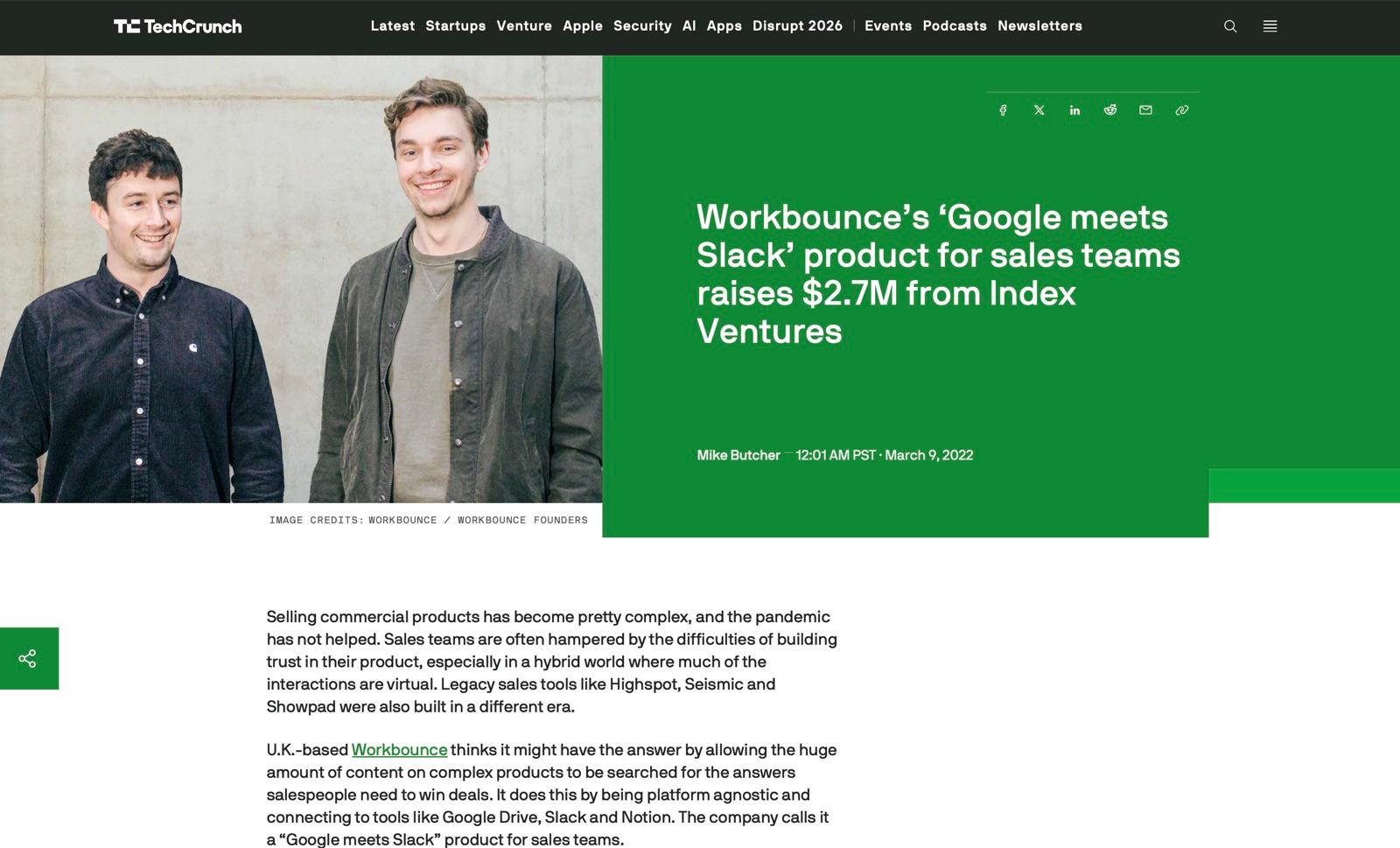
TechCrunch, March 2022 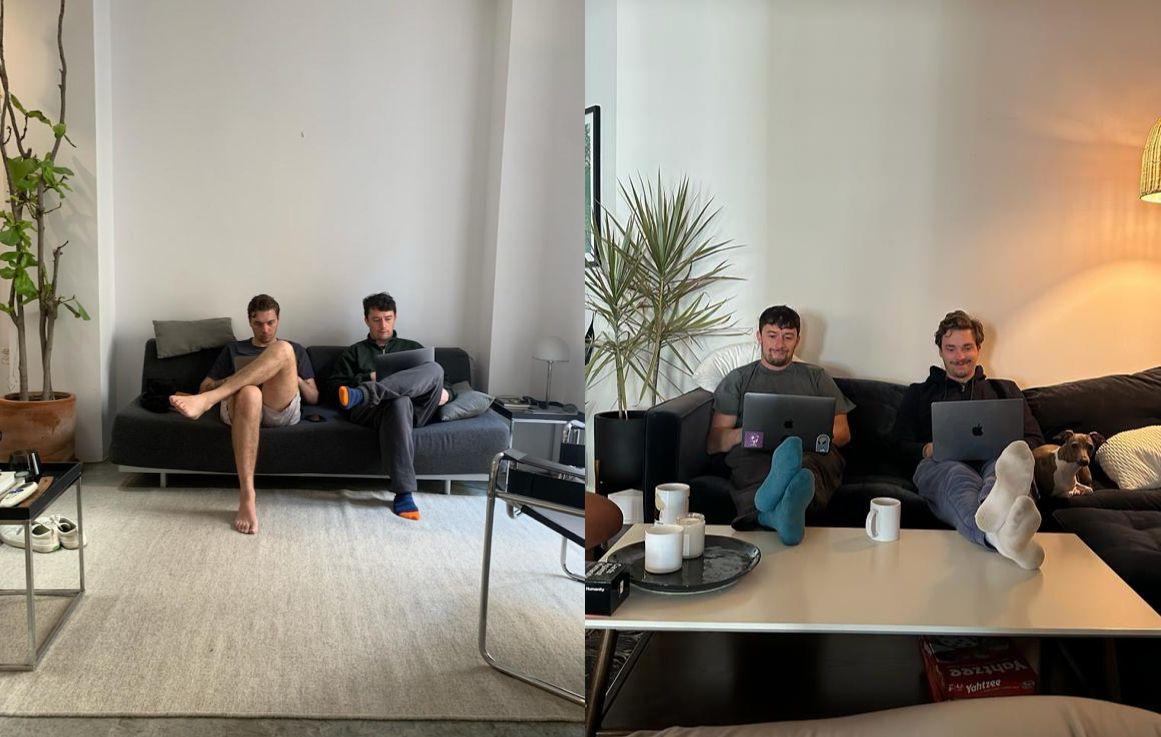
Rowan and me, years apart